Stop Optimizing Cost Center. Start Building Growth Engines.

The Hidden Problem
Companies think they can cut their way to growth. They can’t. Efficiency, cost-cutting, and automation might buy time, but they don’t build the future. As Elon Musk said, “The most common error of a smart engineer is to optimize something that shouldn’t exist.”
That’s exactly what most leaders are doing. They’re working to optimize cost centers, HR, IT, Finance, and the PMO. Their original purpose was to deliver compliance, consistency, and efficiency, not growth. Leaning on them to support growth in their current form can only lead to stalled transformation, missed initiatives, and burnout-busy, because they weren’t designed to create business value.
The truth is simple: if these functions still operate as cost centers, your company is built to control & react, not to grow. The mindset has to shift: from cost center to growth engine.
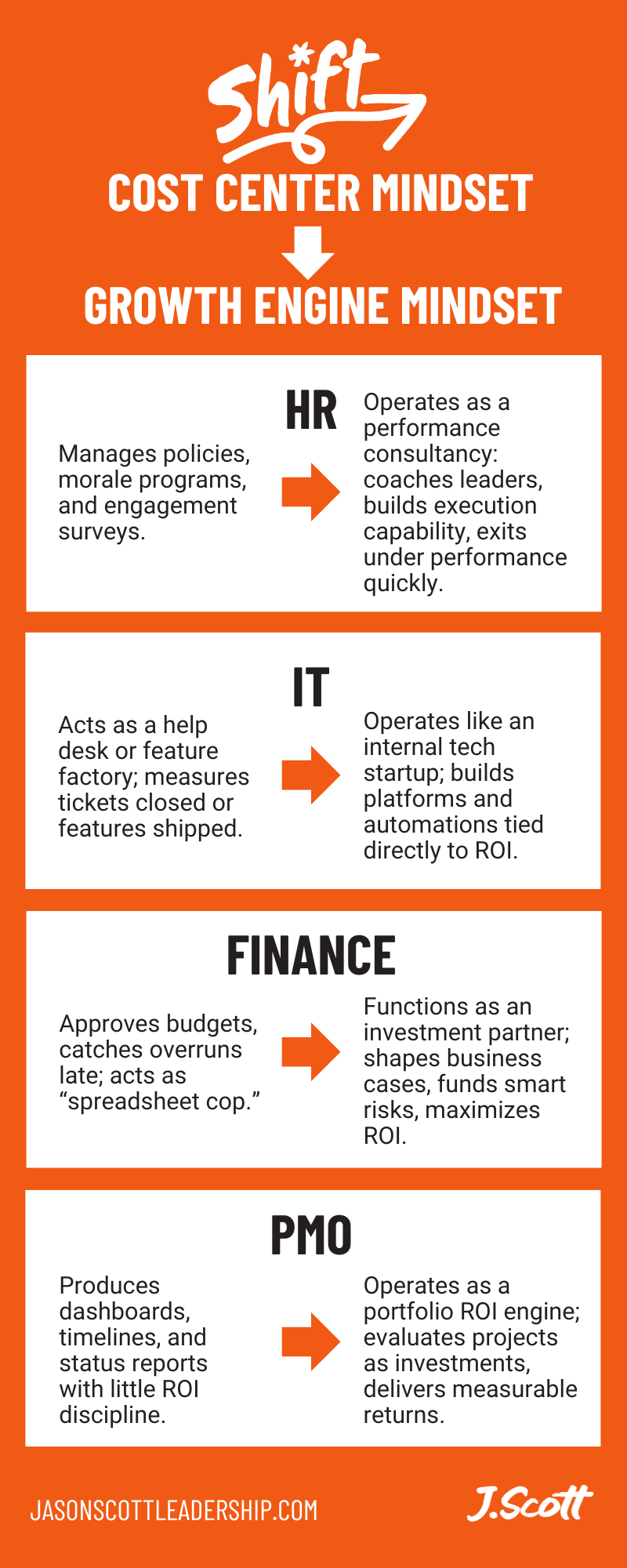
“HR must become a performance consultancy. IT, a tech unicorn. Finance, an investment partner. The PMO, a portfolio ROI engine. In other words: stop running cost centers. Start running growth engines.”
How the Cost Center Mindset Shows Up
HR: From Policy Hub to Performance Engine
In many organizations, HR is rebranded as “People and Culture” but still measured by programs like engagement surveys, morale boosters, and training calendars. These feel strategic but rarely drive performance. The result is culture theater: a lot of effort, little impact, and no measurable lift in execution.
When HR runs as a cost center, it focuses on compliance and morale. When it runs as a growth engine, HR boosts morale by operating as an internal performance consultancy. It embeds coaching and systems that build high-performing teams, drives clarity and discipline across the organization, and quickly exits those who can’t or won’t deliver in service of those who can and will.
IT: From Feature Factory to Tech Unicorn
Most IT teams operate as ticketing systems, saying yes to everything and shipping features with little connection to ROI. The result is tech debt, burnout, and lots of outputs that don’t move the business forward. That’s the feature factory mindset.
When IT is reframed as a growth engine, it functions like an internal tech startup. Its purpose shifts from fulfilling requests to building the future of the business. IT should be proactively designing platforms and automations that eliminate friction, scale execution, and measurably drive both top-line growth and bottom-line efficiency. They need to show up as experts, not ticket takers.
Sidebar: The Wrong Metrics
If IT is judged by tickets closed or features shipped, you’ve already lost. The only metric that matters is a measurable return on investment.
Finance: From Budget Cop to Investment Partner
Finance often shows up late in the process after assumptions are baked and money is spent. It plays the role of spreadsheet cop, catching overruns instead of shaping strategy. By design, this keeps Finance reactive, not generative.
As a growth engine, Finance operates like an embedded investment firm. It partners with leaders early to shape business cases, ensures profitability by design, and funds smart risks that maximize ROI. It doesn’t just control costs, it drives return.
PMO: From Transformation Theater to ROI Engine
PMOs are notorious for producing dashboards, timelines, and red/yellow/green status reports that say little about actual business outcomes. This is transformation theater. Process-heavy and value-light.
As a growth engine, the PMO becomes a portfolio ROI function, an internal Golman Sachs. It evaluates projects as investments, challenges initiatives that don’t meet clear ROI criteria, and ensures the company’s most expensive bets (its strategic projects) deliver measurable returns in customer satisfaction, team member satisfaction, and profitability.
Lessons from the Field
I’ve seen both sides of this firsthand.
At DirecTV, the PMO was excellent at producing reports but not accountable for ROI. Projects looked green on paper but weren’t in reality. People were scared to tell the truth, and most weren’t upskilled to be effective project managers. They improvised, and the results showed it. IT leadership was frustrated, and the pressure never let up. My team delivered 227% better results in the same environment because we cut through the noise and applied the 120VC standard to turn IT projects into ROI.
At Activision, HR went beyond being a policy function. It embedded execution leadership into the daily work of managers. Performance & morale didn’t rise because of engagement programs. It rose because leaders were coached to lead.
At ResMed, IT was treated as a help desk until we flipped the model. Once it operated like a tech startup, IT began delivering platforms that scaled execution across the company, eliminated bottlenecks, and measurably improved customer satisfaction, team member satisfaction, and profitability, none at the expense of the other.
At Sony, Finance had been the brake until we reframed it as the accelerator. Instead of shutting ideas down with spreadsheets, Finance partnered early to shape profitable strategies. That shift unlocked innovation instead of stifling it.
“Every transformation confirmed the same truth: cost centers drain value. Growth engines multiply it.”
What a Post–Cost Center Company Looks Like
When HR, IT, Finance, and the PMO operate as growth engines, the organization stops reacting and starts compounding results:
● HR functions as a performance consultancy.
● IT operates as an internal tech unicorn with a billion-dollar valuation pre-revenue.
● Finance becomes an investment partner.
● The PMO drives portfolio ROI, not process.
The company no longer runs on silos. It runs on a unified execution engine. Volatility no longer derails performance. Uncertainty no longer paralyzes decision-making. Complexity no longer overwhelms strategy.
This isn’t culture theater. It’s operational truth.
The Leadership Shift
Killing the cost center is not a re-org or a new automation tool. It’s a leadership decision. It requires reframing functions around a simple, non-negotiable discipline: every initiative must measurably improve customer satisfaction, team member satisfaction, or profitability—none at the expense of the others.
This is the CORE system:
● Clarity of Intent
● Operational Discipline
● Relentless Execution
● Engineered Trust
It’s not theory. It’s a proven operating model for growth.
Sidebar: The CORE Lens If an initiative can’t clearly communicate how it will measurably improve customer satisfaction, team member satisfaction, or profitability—none at the expense of the others—it doesn’t get funded.
Where to Begin
The shift starts with a single question. Ask it in every meeting, every planning session, every investment review:
“How does this improve customer satisfaction, team member satisfaction, or profitability, none at the expense of the others?”
If the answer isn’t clear, stop the work, redefine it, or kill it. That question exposes theater and forces value.
It’s not a program. It’s not a transformation office. It’s a mindset shift that builds companies designed to win, not just survive.
The Bottom Line
Leaders who continue to optimize cost centers will keep getting the same results: transformation fatigue, missed goals, and burned-out teams. Leaders who kill the cost center and reframe HR, IT, Finance, and the PMO as growth engines will build companies that compound results no matter what the market throws at them.
The choice is clear: Optimize for survival, or design for growth.